Home
Home
Designing a Ratings & Reviews System for Fab
Designing a Ratings & Reviews System for Fab
Helping buyers make more confident purchase decisions and giving creators a clearer way to build trust.
Helping buyers make more confident purchase decisions and giving creators a clearer way to build trust.
Designing a Ratings & Reviews System for Fab
Improving trust and decision-making for creators and buyers
Designing a Ratings & Reviews System for Fab
Helping buyers make more confident purchase decisions and giving creators a clearer way to build trust.
Designing a Ratings & Reviews System for Fab
Helping buyers make more confident purchase decisions and giving creators a clearer way to build trust.
Designing a Ratings & Reviews System for Fab
Helping buyers make more confident purchase decisions and giving creators a clearer way to build trust.
The problem
The problem
Fab is a marketplace for buying and selling digital assets. However, buyers had limited signals to help them evaluate quality before making a purchase. That created a trust gap. If users couldn’t quickly understand whether an asset was reliable, useful, or worth buying, decision-making became harder and the marketplace experience felt weaker.
This created a dual challenge: buyers needed more confidence, and creators needed a better way to surface meaningful feedback about their work.
Fab is a marketplace for buying and selling digital assets. However, buyers had limited signals to help them evaluate quality before making a purchase. That created a trust gap. If users couldn’t quickly understand whether an asset was reliable, useful, or worth buying, decision-making became harder and the marketplace experience felt weaker.
This created a dual challenge: buyers needed more confidence, and creators needed a better way to surface meaningful feedback about their work.
The team
The team
Product manager
Product manager
Product manager
Engineers
Engineers
Engineers
UX writer
UX writer
UX writer
My role
My role
Benchmarking & research
Benchmarking & research
Benchmarking & research
Conceptualization
Conceptualization
Conceptualization
Design
Design
Design
End-to-end flow definition
End-to-end flow definition
End-to-end flow definition
Dev handoff
Dev handoff
Dev handoff
I led the product design for the ratings and reviews experience, evolving the existing rating flow into a fuller review system through interaction design, UI, benchmarking, and developer handoff.
I led the product design for the ratings and reviews experience, evolving the existing rating flow into a fuller review system through interaction design, UI, benchmarking, and developer handoff.
What I wanted to achieve
What I wanted to achieve
My goal was to design a ratings and reviews system that felt trustworthy, useful, and easy to scan. It needed to help buyers make more informed decisions without overwhelming the experience, while also giving creators more meaningful feedback they could learn from over time.
My goal was to design a ratings and reviews system that felt trustworthy, useful, and easy to scan. It needed to help buyers make more informed decisions without overwhelming the experience, while also giving creators more meaningful feedback they could learn from over time.
Why this mattered
Why this mattered
Trust is a critical part of any marketplace experience. Without clear signals to help buyers evaluate quality, purchase decisions become harder and the product feels riskier to use. Ratings and reviews helped strengthen that layer of trust while also giving creators a better feedback loop.
Trust is a critical part of any marketplace experience. Without clear signals to help buyers evaluate quality, purchase decisions become harder and the product feels riskier to use. Ratings and reviews helped strengthen that layer of trust while also giving creators a better feedback loop.
How I approached it
How I approached it
Fab already had ratings in place, but not a fuller reviews experience that gave buyers useful context and creators more meaningful feedback. My role was to evolve that system into something more trustworthy, useful, and easier to engage with, while also considering expectations inherited from Unreal Engine Marketplace. I started by looking at how review systems commonly work across digital products, then narrowed in on the patterns that would feel most useful in a marketplace context.
The challenge was not simply adding reviews, but deciding how much trust-building information to surface without making the experience feel heavier or slowing down evaluation.
I focused the work around three core questions:
Fab already had ratings in place, but not a fuller reviews experience that gave buyers useful context and creators more meaningful feedback. My role was to evolve that system into something more trustworthy, useful, and easier to engage with, while also considering expectations inherited from Unreal Engine Marketplace. I started by looking at how review systems commonly work across digital products, then narrowed in on the patterns that would feel most useful in a marketplace context.
The challenge was not simply adding reviews, but deciding how much trust-building information to surface without making the experience feel heavier or slowing down evaluation.
I focused the work around three core questions:
What helps buyers make decisions quickly?
What helps buyers make decisions quickly?
Quick-scan trust signals, clear rating visibility, and written feedback that adds useful context without overwhelming the page.
Quick-scan trust signals, clear rating visibility, and written feedback that adds useful context without overwhelming the page.
Where should ratings and reviews appear across the experience?
Where should ratings and reviews appear across the experience?
In the places where users are actively evaluating an asset, especially on listing and detail surfaces where trust and comparison matter most.
In the places where users are actively evaluating an asset, especially on listing and detail surfaces where trust and comparison matter most.
How can the system support both trust and usability for buyers and creators?
How can the system support both trust and usability for buyers and creators?
By giving buyers enough information to judge quality confidently, while giving creators a structured, meaningful way to receive feedback.
By giving buyers enough information to judge quality confidently, while giving creators a structured, meaningful way to receive feedback.
The solution
The solution
So what did this actually look like in practice?
So what did this actually look like in practice?
Ratings summary
Ratings summary
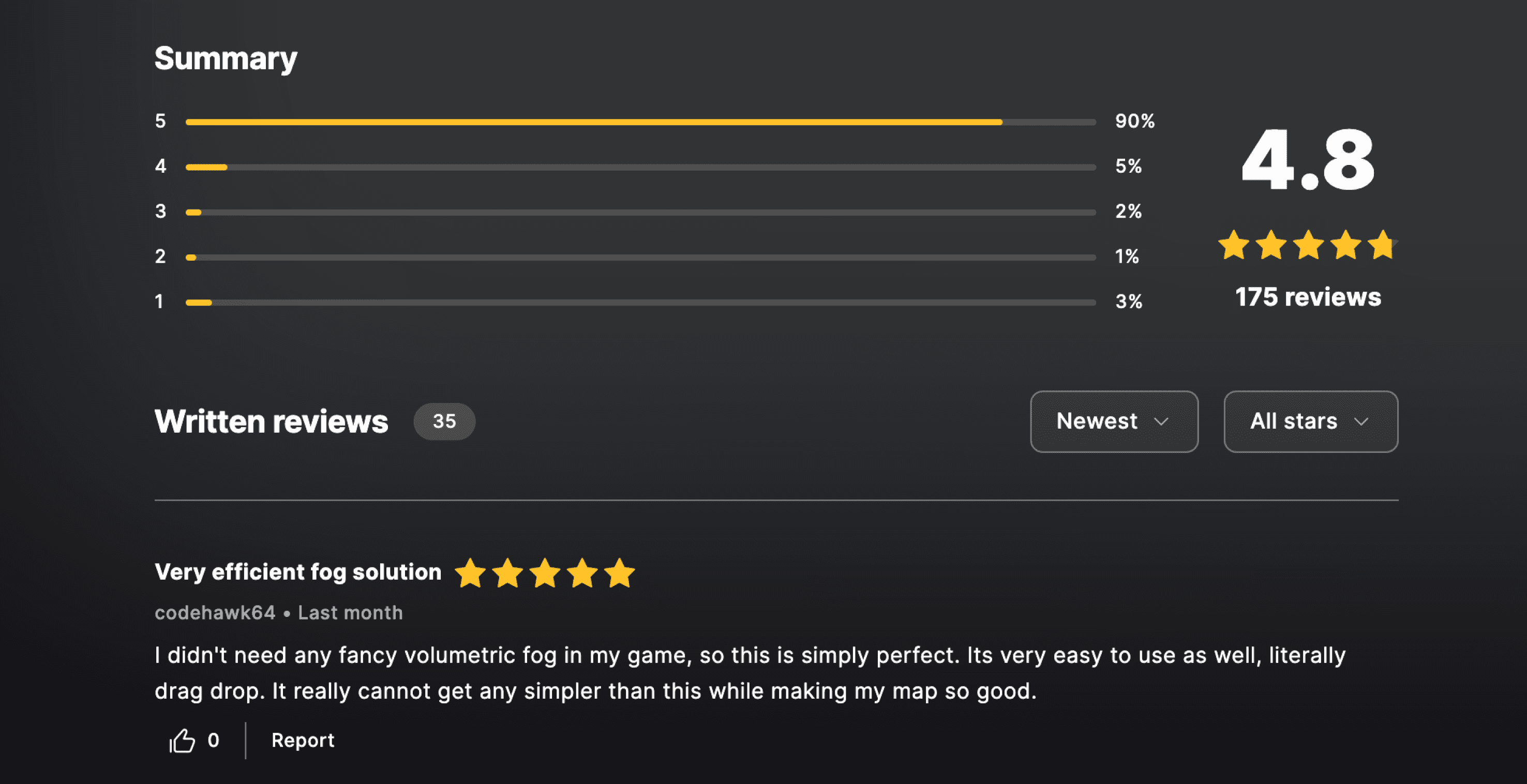
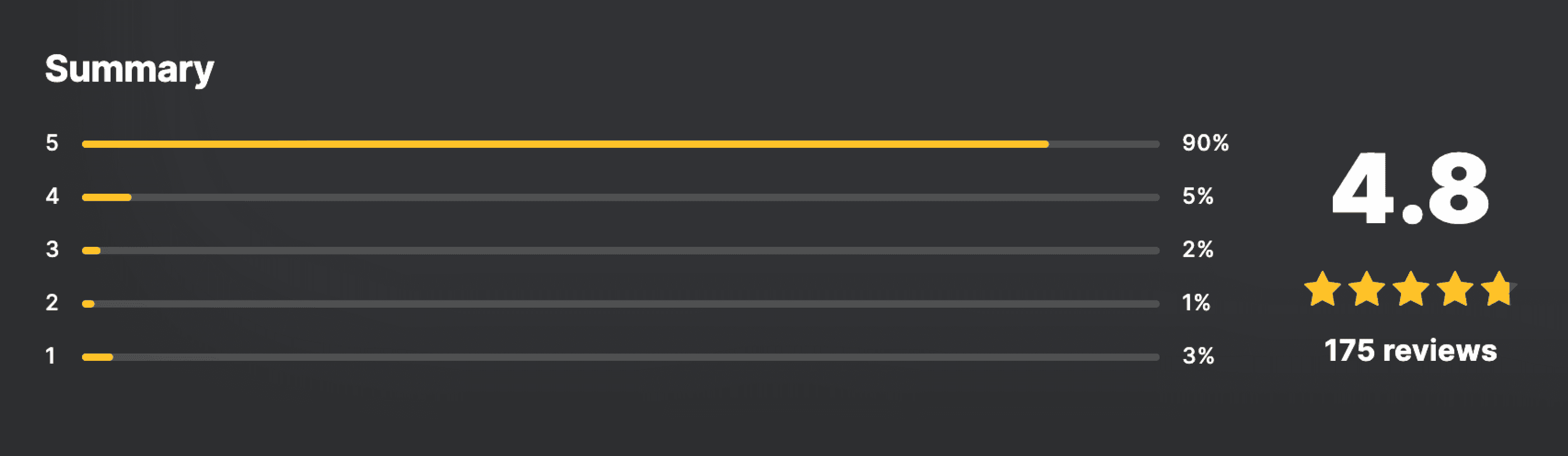
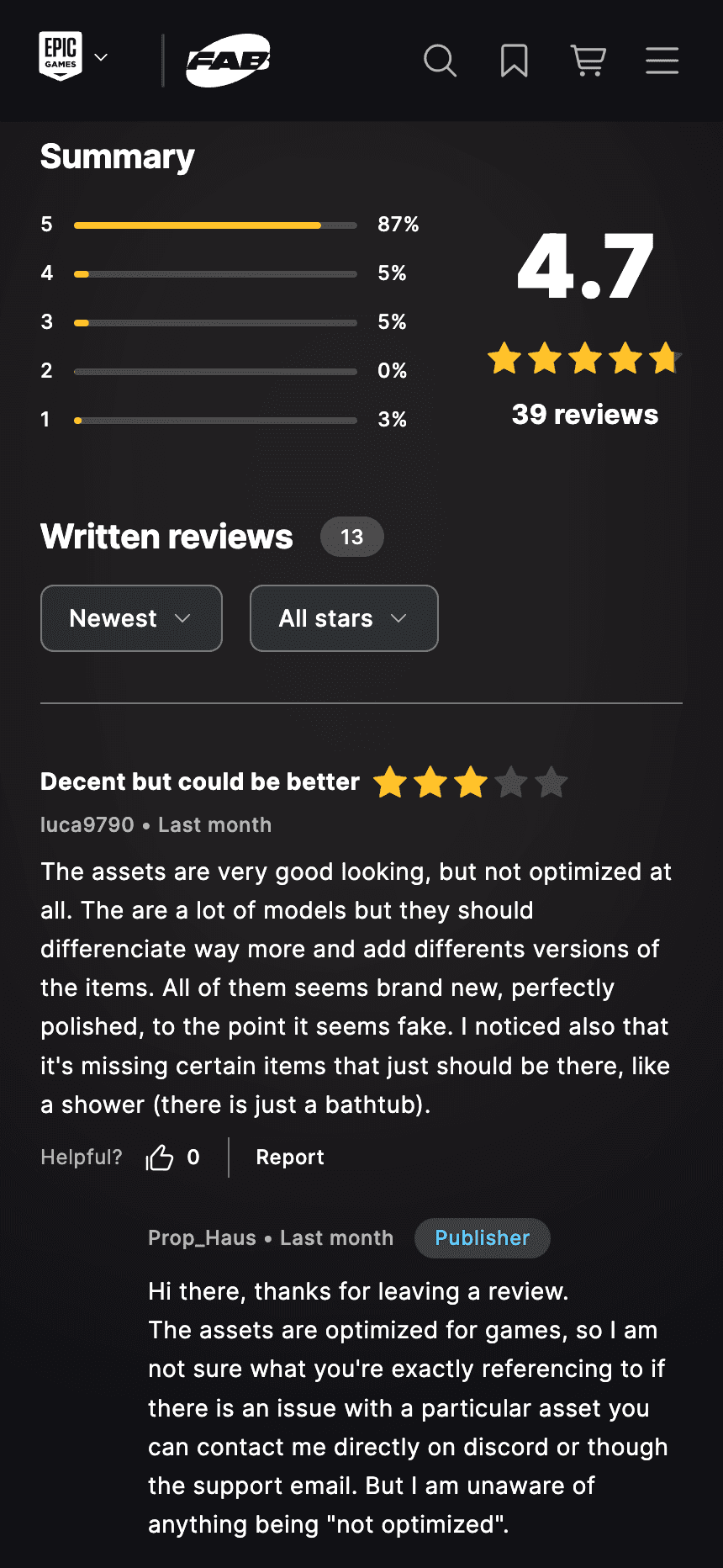
I focused on making the overall rating easy to understand at a glance, highlighting the average score while giving visibility into how ratings are distributed.
I focused on making the overall rating easy to understand at a glance, highlighting the average score while giving visibility into how ratings are distributed.
Written reviews
Written reviews
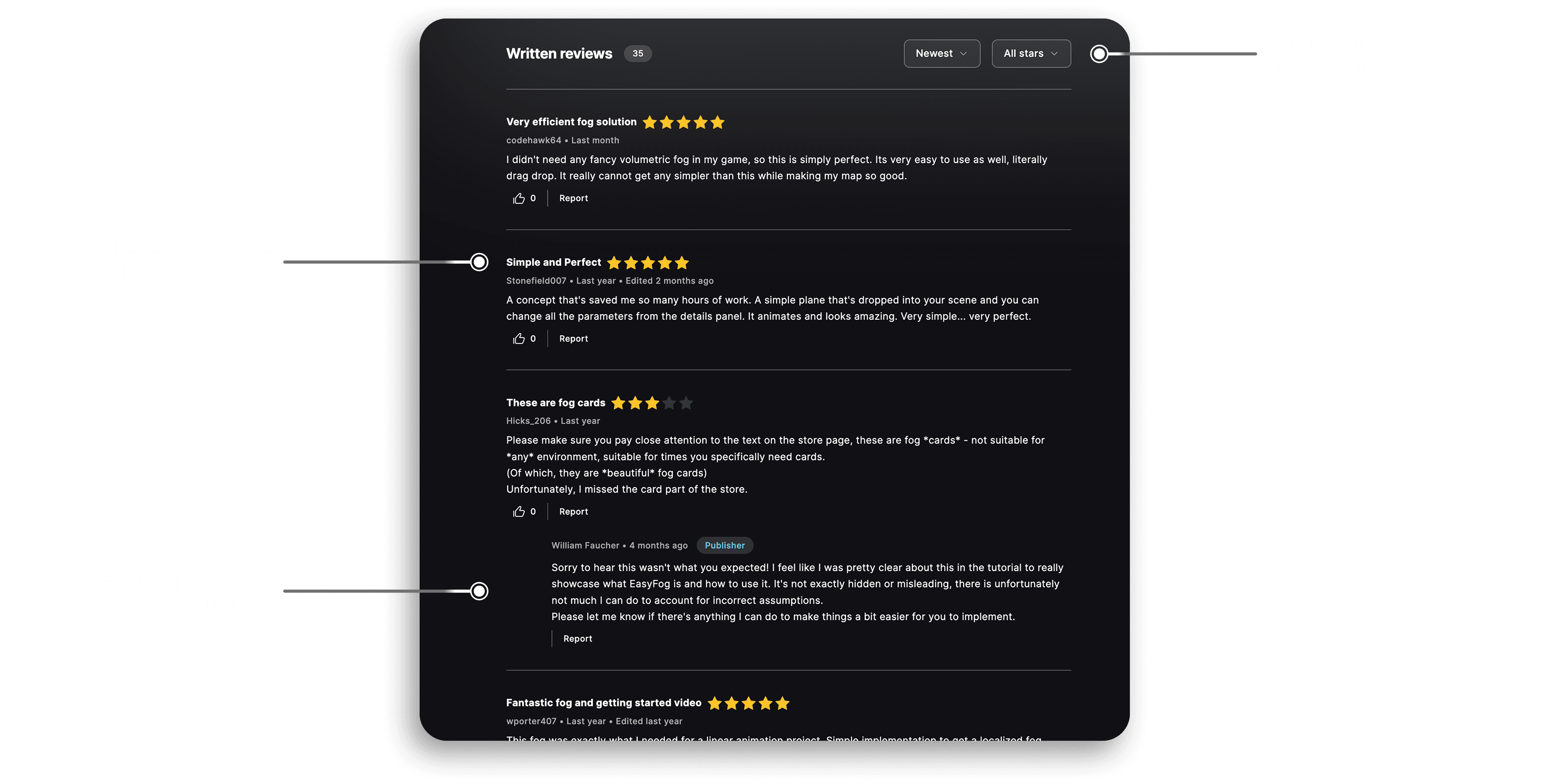
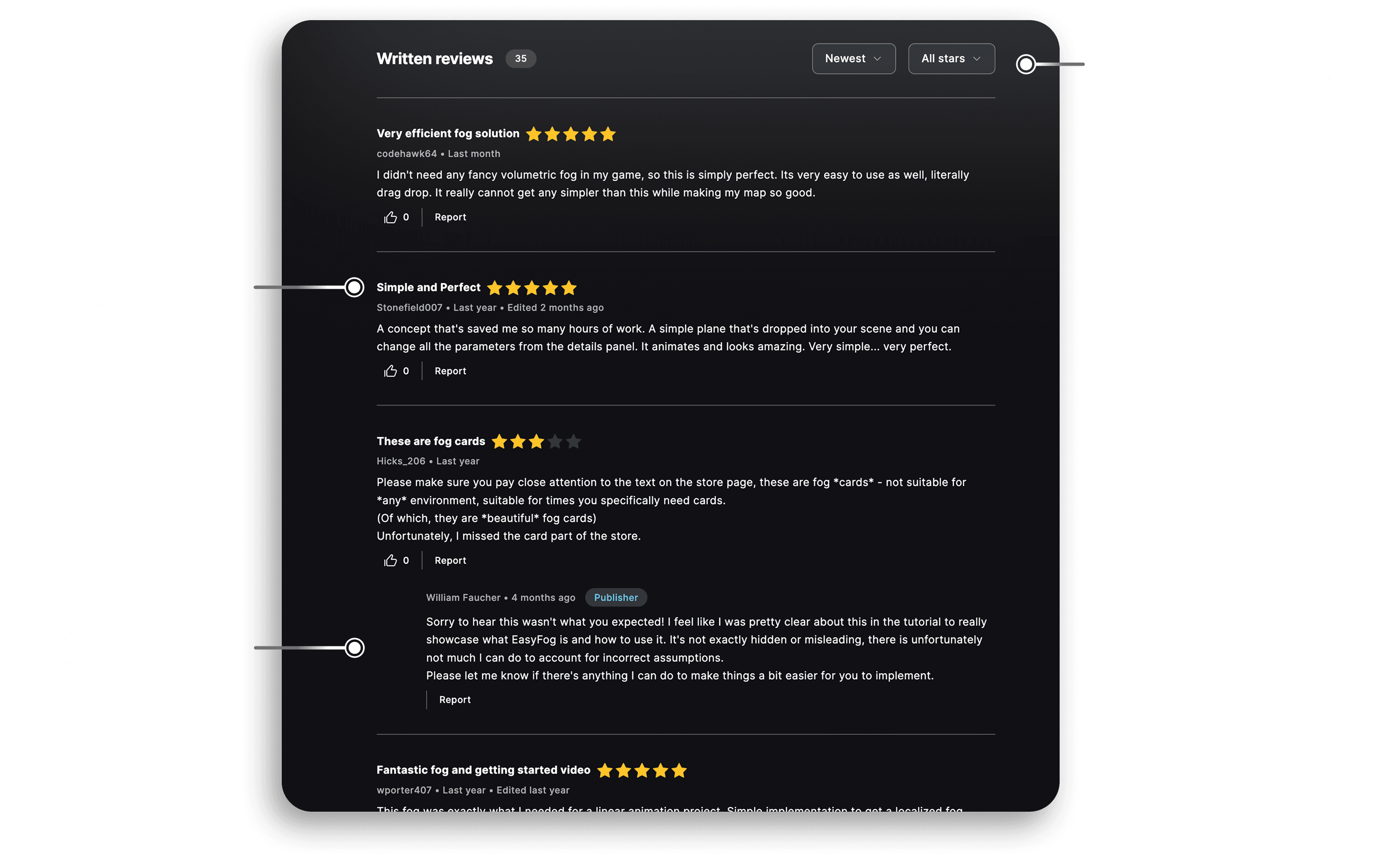
Ratings helped users scan quickly, but written reviews added the context buyers needed to evaluate an asset with more confidence. I designed the review list to make feedback easier to sort, browse, and interpret, while keeping the experience lightweight enough to support quick scanning.
Ratings helped users scan quickly, but written reviews added the context buyers needed to evaluate an asset with more confidence. I designed the review list to make feedback easier to sort, browse, and interpret, while keeping the experience lightweight enough to support quick scanning.
Leaving a review
Leaving a review
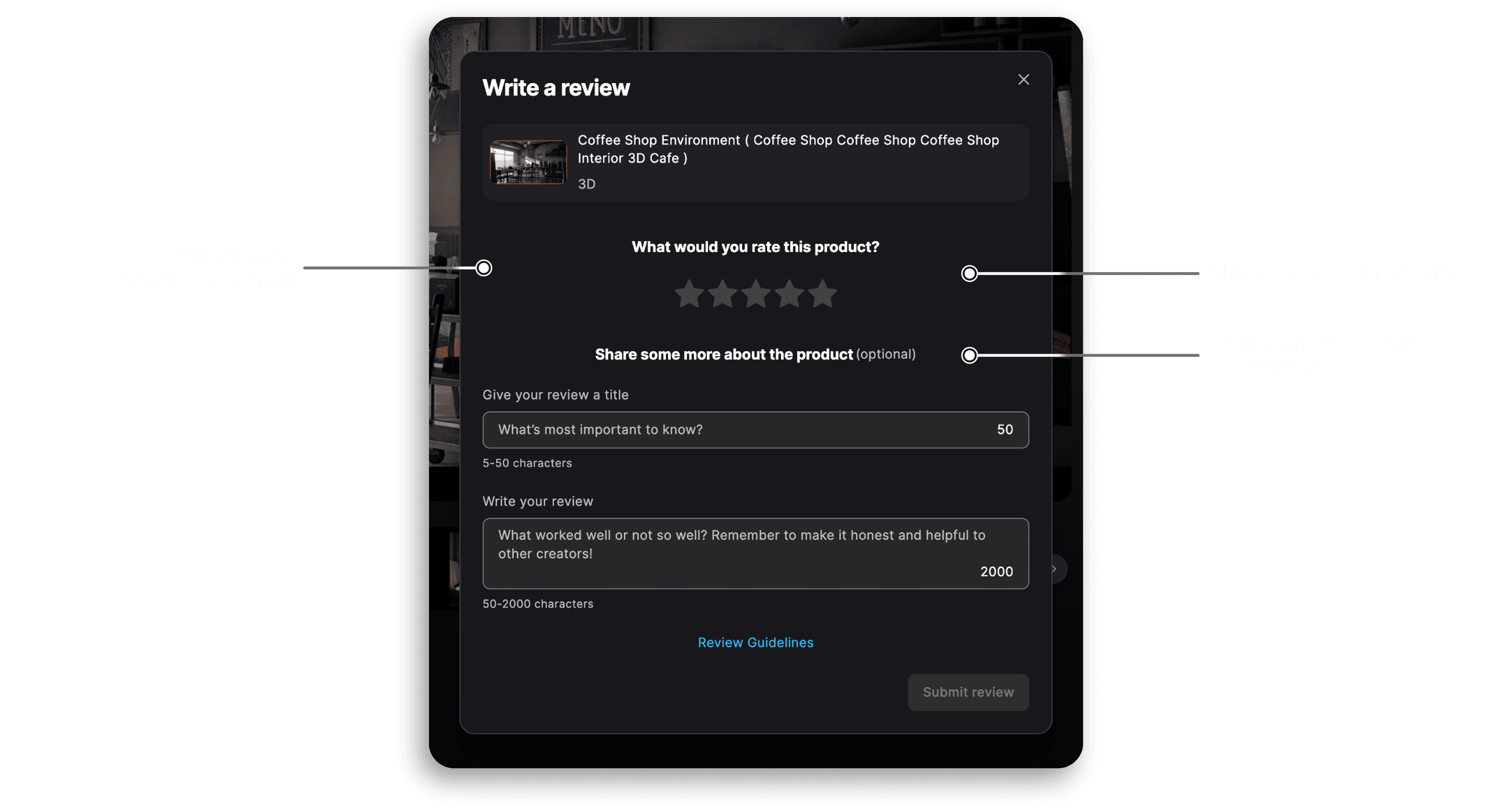
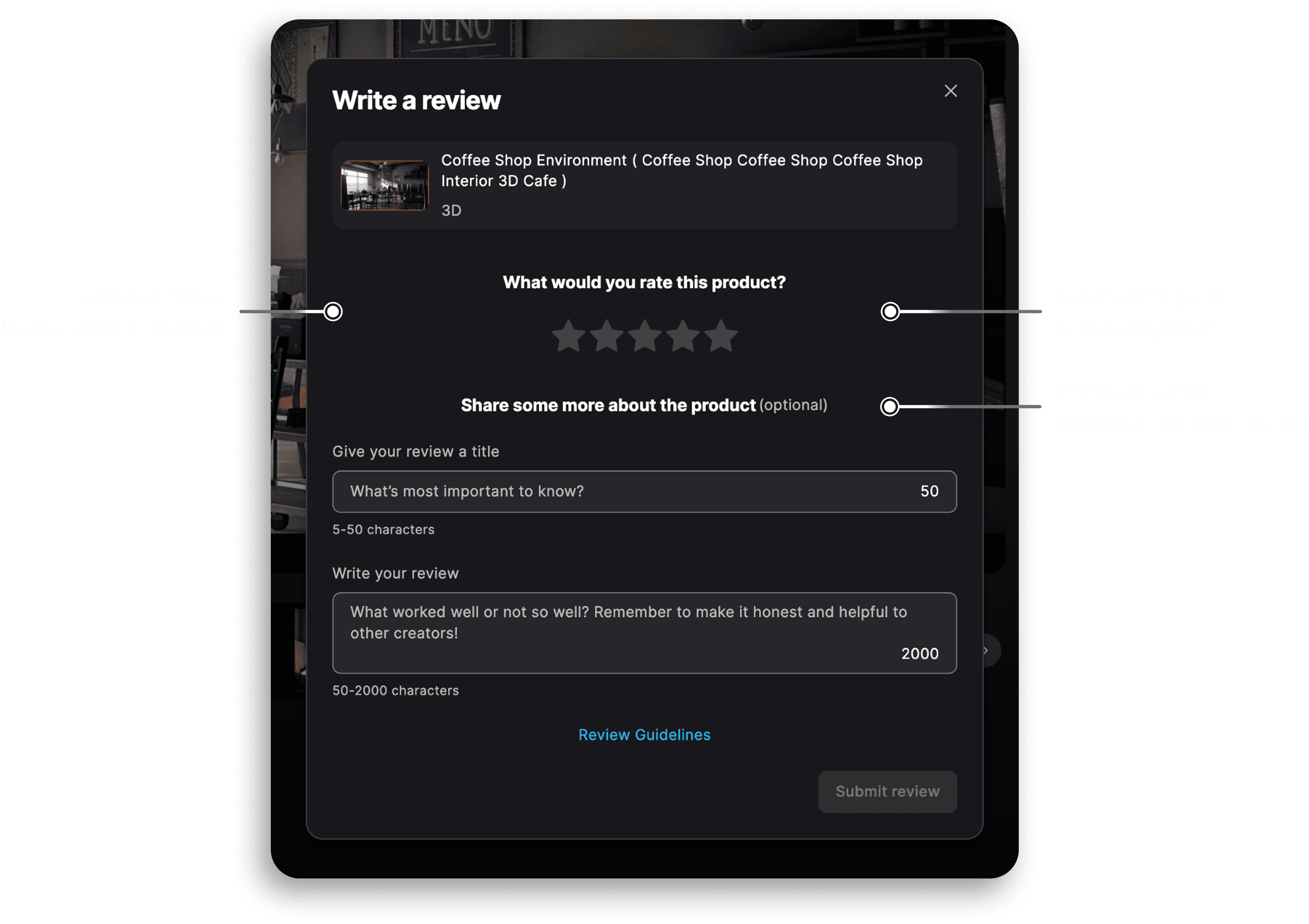
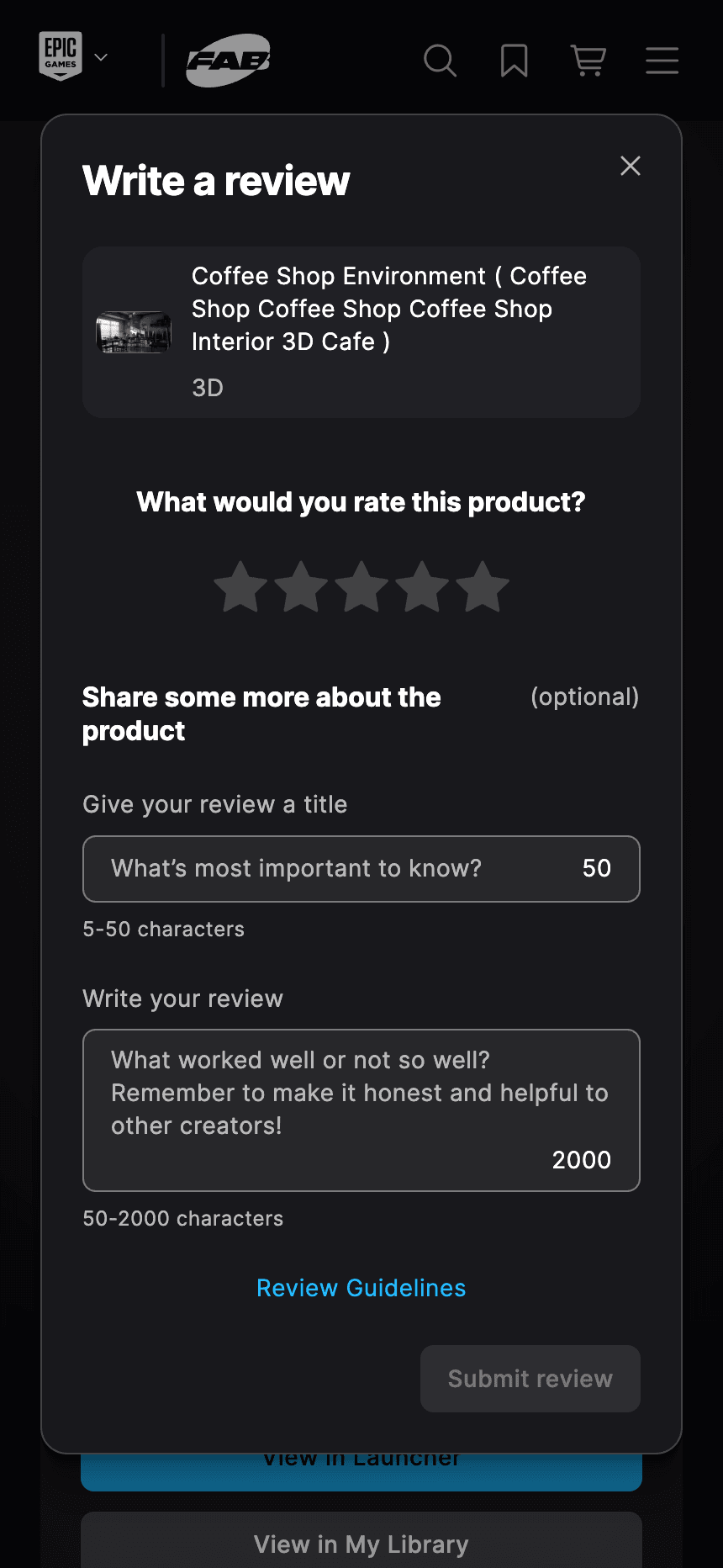
I evolved the existing ratings submission flow into a fuller review experience that felt straightforward and low-friction. The goal was to encourage more meaningful feedback without making the process feel heavy. That meant keeping the structure simple, making the star rating easy to understand, and giving written feedback an optional but visible place in the flow.
I evolved the existing ratings submission flow into a fuller review experience that felt straightforward and low-friction. The goal was to encourage more meaningful feedback without making the process feel heavy. That meant keeping the structure simple, making the star rating easy to understand, and giving written feedback an optional but visible place in the flow.
Responsive considerations
Responsive considerations
Because Fab exists across desktop and smaller screens, the ratings and reviews experience needed to stay clear and usable in more constrained spaces.
On mobile, I prioritized the most important trust signals first, such as the overall rating and review highlights, while making it easy to expand into deeper written feedback when needed. Layout, hierarchy, and interaction patterns were adapted to support quick scanning without overwhelming the experience.
Because Fab exists across desktop and smaller screens, the ratings and reviews experience needed to stay clear and usable in more constrained spaces.
On mobile, I prioritized the most important trust signals first, such as the overall rating and review highlights, while making it easy to expand into deeper written feedback when needed. Layout, hierarchy, and interaction patterns were adapted to support quick scanning without overwhelming the experience.
What changed?
What changed?
With ratings and reviews in place, the marketplace gained stronger trust signals at the point where users were actively evaluating assets.
With ratings and reviews in place, the marketplace gained stronger trust signals at the point where users were actively evaluating assets.
Reviews became a two-way conversation, not just a one-way rating
Reviews became a two-way conversation, not just a one-way rating
Buyers could assess quality at a glance and go deeper when needed
Buyers could assess quality at a glance and go deeper when needed
Written reviews added context that made decisions feel more informed
Written reviews added context that made decisions feel more informed
Creators gained clearer, more actionable feedback about their work
Creators gained clearer, more actionable feedback about their work
It wasn’t one single dramatic change. It was a set of small, intentional product decisions that made the marketplace feel more trustworthy and easier to navigate.
It wasn’t one single dramatic change. It was a set of small, intentional product decisions that made the marketplace feel more trustworthy and easier to navigate.
Looking back
Looking back
There is still more this system could have become.
One area I found especially interesting was the creator side. Individual reviews were useful, but they still required creators to piece together feedback comment by comment. I started exploring ways the system could go further by surfacing broader patterns over time, including ideas around AI-assisted sentiment summaries and recurring themes.
That direction never moved beyond exploration, but it pointed to a bigger opportunity: turning reviews from isolated feedback into a more useful learning tool for creators.
There is still more this system could have become.
One area I found especially interesting was the creator side. Individual reviews were useful, but they still required creators to piece together feedback comment by comment. I started exploring ways the system could go further by surfacing broader patterns over time, including ideas around AI-assisted sentiment summaries and recurring themes.
That direction never moved beyond exploration, but it pointed to a bigger opportunity: turning reviews from isolated feedback into a more useful learning tool for creators.