Home
Home
Designing School Profiles for ArtStation
Designing School Profiles for ArtStation
Creating a dedicated experience for schools to showcase programs, connect with students, and improve discoverability on ArtStation.
Creating a dedicated experience for schools to showcase programs, connect with students, and improve discoverability on ArtStation.
Designing School Profiles for ArtStation
Creating a dedicated experience for schools to showcase programs, connect with students, and improve discoverability on ArtStation.
Designing School Profiles for ArtStation
Creating a dedicated experience for schools to showcase programs, connect with students, and improve discoverability on ArtStation.
The problem
The problem
ArtStation had a growing number of schools, but no clear way to represent them on the platform.
Schools were not just another type of user. They attract students, run programs, showcase graduate work, and connect people to the industry, but none of that was clearly expressed.
As a result, schools could not properly communicate what they offered, and students had no clear way to understand or compare their options. There was also no strong way for students or alumni to show affiliation, which made trust harder to establish.
ArtStation had a growing number of schools, but no clear way to represent them on the platform.
Schools were not just another type of user. They attract students, run programs, showcase graduate work, and connect people to the industry, but none of that was clearly expressed.
As a result, schools could not properly communicate what they offered, and students had no clear way to understand or compare their options. There was also no strong way for students or alumni to show affiliation, which made trust harder to establish.
The team
The team
Product manager
Product manager
Product manager
Engineers
Engineers
Engineers
My role
My role
Research
Research
Research
Information architecture
Information architecture
Information architecture
Design
Design
Design
Dev handoff
Dev handoff
Dev handoff
I led the product design work for School Profiles on ArtStation, shaping how schools were represented across profile structure, discovery surfaces, and community visibility from concept through to developer handoff.
I led the product design work for School Profiles on ArtStation, shaping how schools were represented across profile structure, discovery surfaces, and community visibility from concept through to developer handoff.
What I wanted to achieve
What I wanted to achieve
My goal was to create a dedicated space for schools that clearly communicated what they offered and why it mattered.
That meant helping schools present their programs, highlight graduate work, and attract prospective students. At the same time, I needed to give users a clearer way to understand, compare, and explore different options.
I also wanted to introduce a stronger sense of affiliation, so students and alumni could be visibly connected to a school in a way that built trust and credibility across the platform.
My goal was to create a dedicated space for schools that clearly communicated what they offered and why it mattered.
That meant helping schools present their programs, highlight graduate work, and attract prospective students. At the same time, I needed to give users a clearer way to understand, compare, and explore different options.
I also wanted to introduce a stronger sense of affiliation, so students and alumni could be visibly connected to a school in a way that built trust and credibility across the platform.
Why this mattered
Why this mattered
Schools were already part of the ArtStation ecosystem, but they were not represented in a way that matched their role on the platform. Supporting them more intentionally made the experience more useful for schools, more understandable for prospective students, and more credible for students and alumni showing affiliation.
Schools were already part of the ArtStation ecosystem, but they were not represented in a way that matched their role on the platform. Supporting them more intentionally made the experience more useful for schools, more understandable for prospective students, and more credible for students and alumni showing affiliation.
How I approached it
How I approached it
Bringing schools into ArtStation meant defining a new kind of presence on the platform, not just adapting an existing pattern.
Bringing schools into ArtStation meant defining a new kind of presence on the platform, not just adapting an existing pattern.
What defines a school profile?
What defines a school profile?
Schools needed to communicate structured information like programs, disciplines, formats, and tools in a way that users could understand at a glance.
Schools needed to communicate structured information like programs, disciplines, formats, and tools in a way that users could understand at a glance.
How do I structure it clearly?
How do I structure it clearly?
I focused on giving schools a profile that felt familiar enough to navigate, while still allowing each one to present what made it distinct.
I focused on giving schools a profile that felt familiar enough to navigate, while still allowing each one to present what made it distinct.
How are schools discovered?
How are schools discovered?
The experience could not stop at the profile itself. Filters, search, and structured metadata all played a key role in helping users explore and compare schools in a meaningful way.
The experience could not stop at the profile itself. Filters, search, and structured metadata all played a key role in helping users explore and compare schools in a meaningful way.
The solution
The solution
So what did this actually look like in practice?
So what did this actually look like in practice?
School profile
School profile
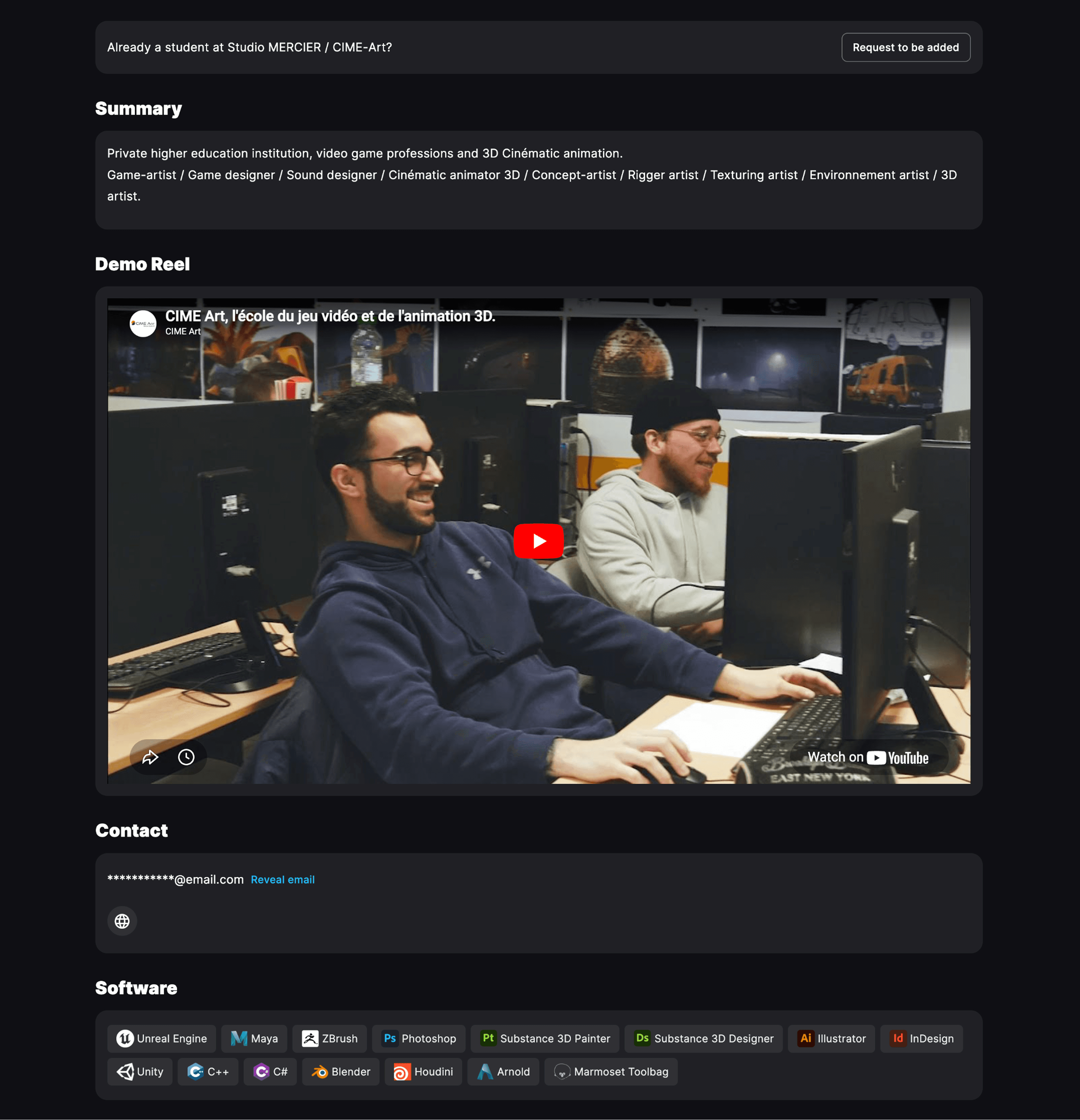
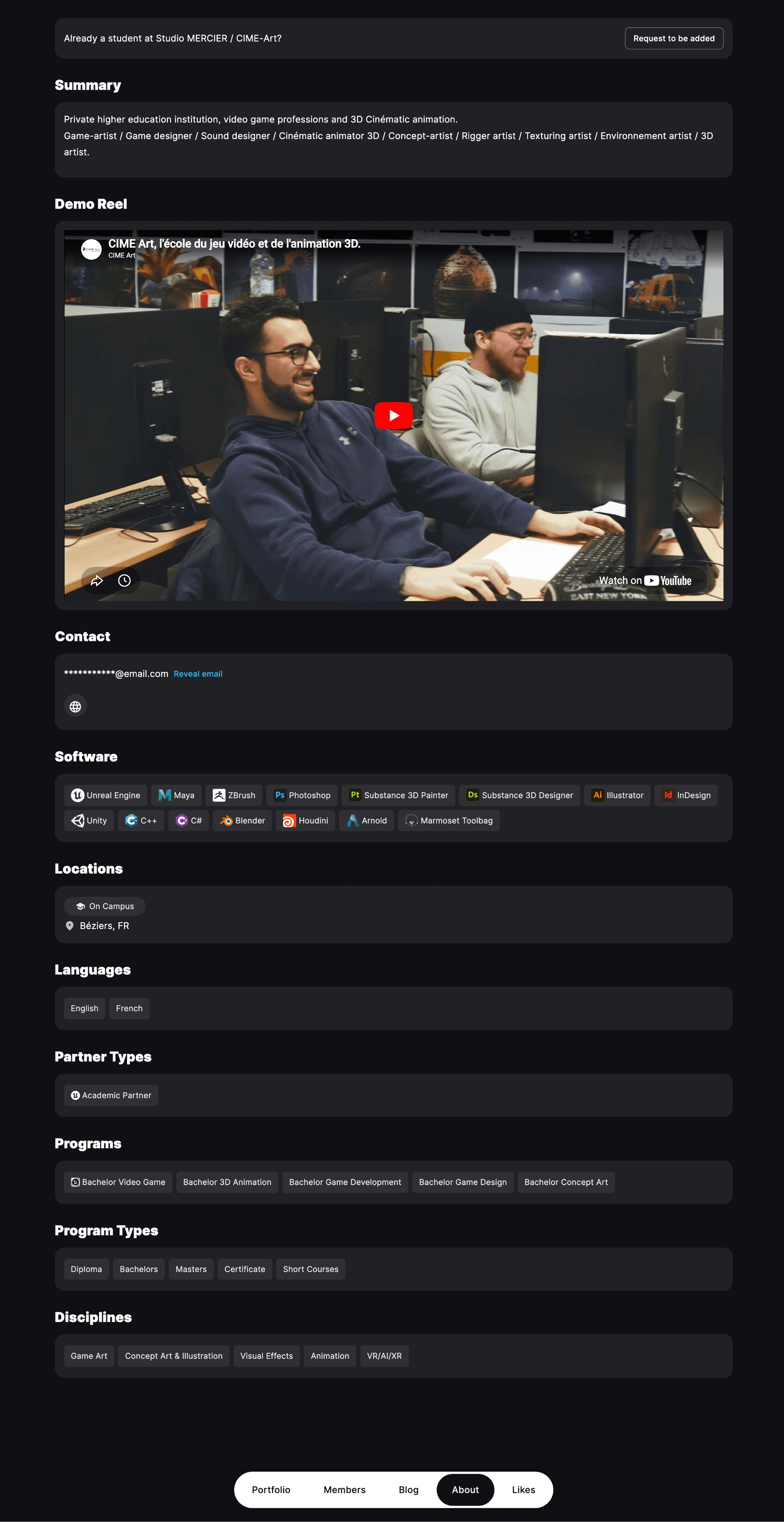
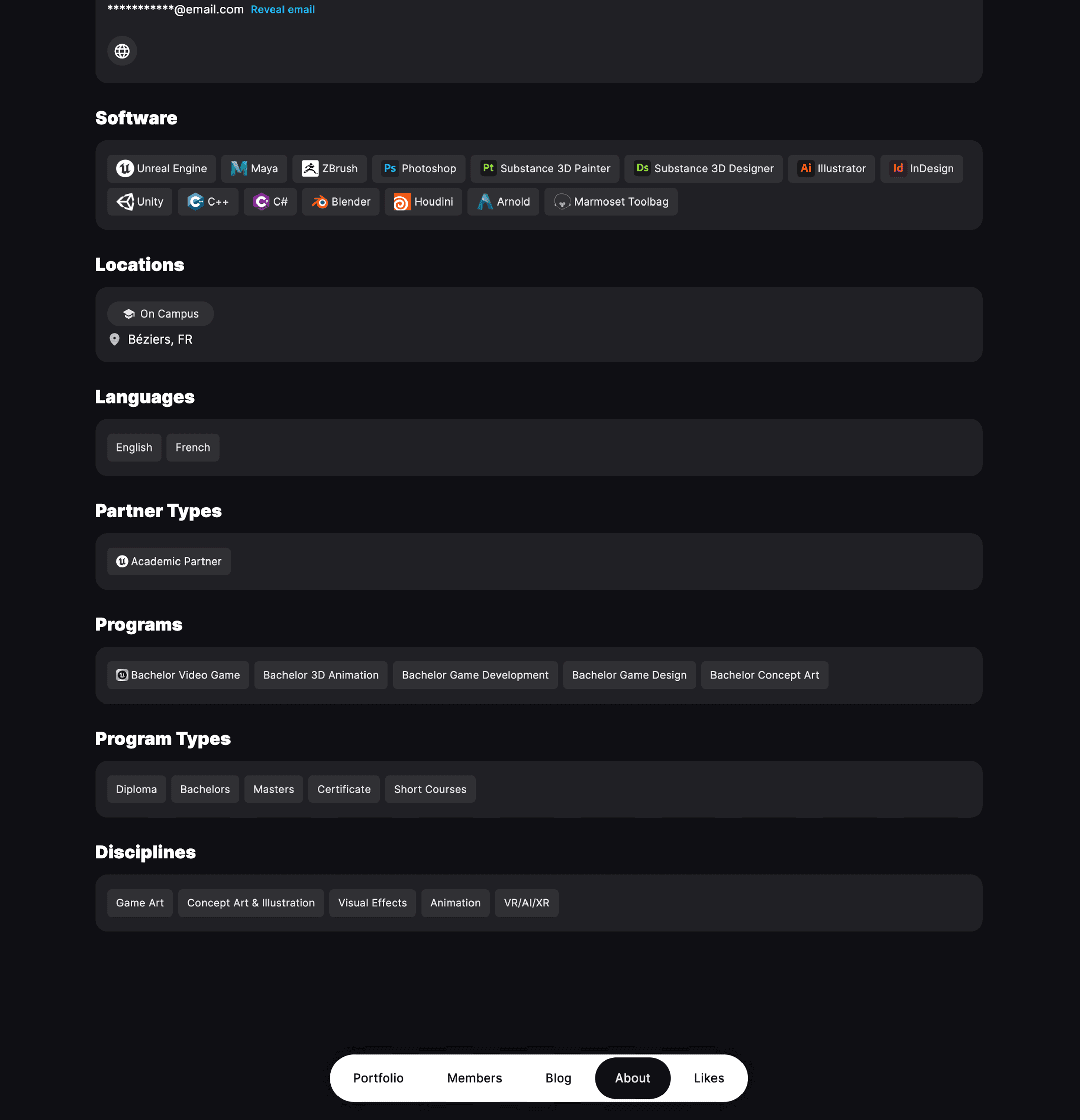
The core of the experience was a dedicated profile that brought together everything a school needed to communicate.
Information was structured into clear sections such as programs, disciplines, formats, and tools, making it easier to scan while still providing depth. The goal was to help users quickly understand what a school offered without needing to dig through unstructured content.
The core of the experience was a dedicated profile that brought together everything a school needed to communicate.
Information was structured into clear sections such as programs, disciplines, formats, and tools, making it easier to scan while still providing depth. The goal was to help users quickly understand what a school offered without needing to dig through unstructured content.
Beyond a static profile
Beyond a static profile
The profile was only one part of the experience.
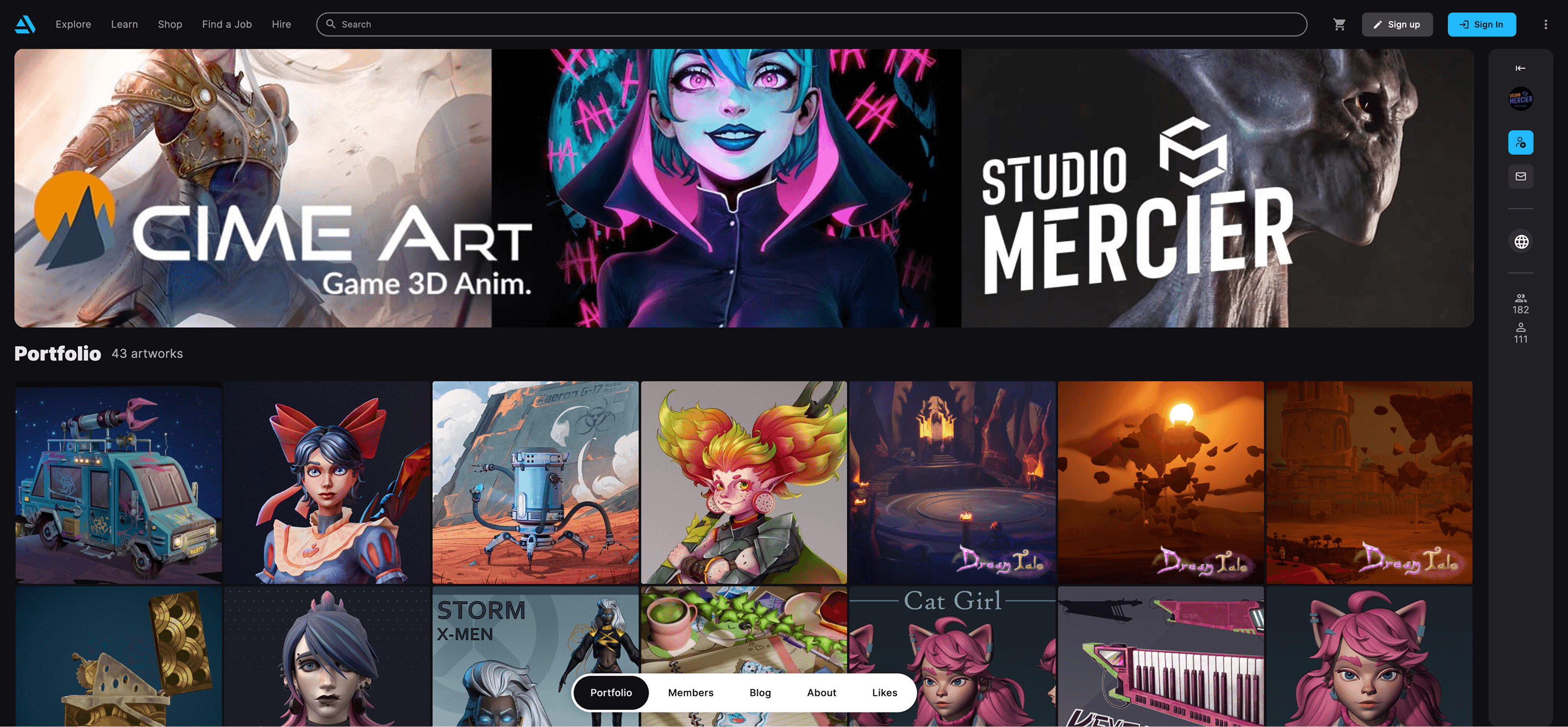
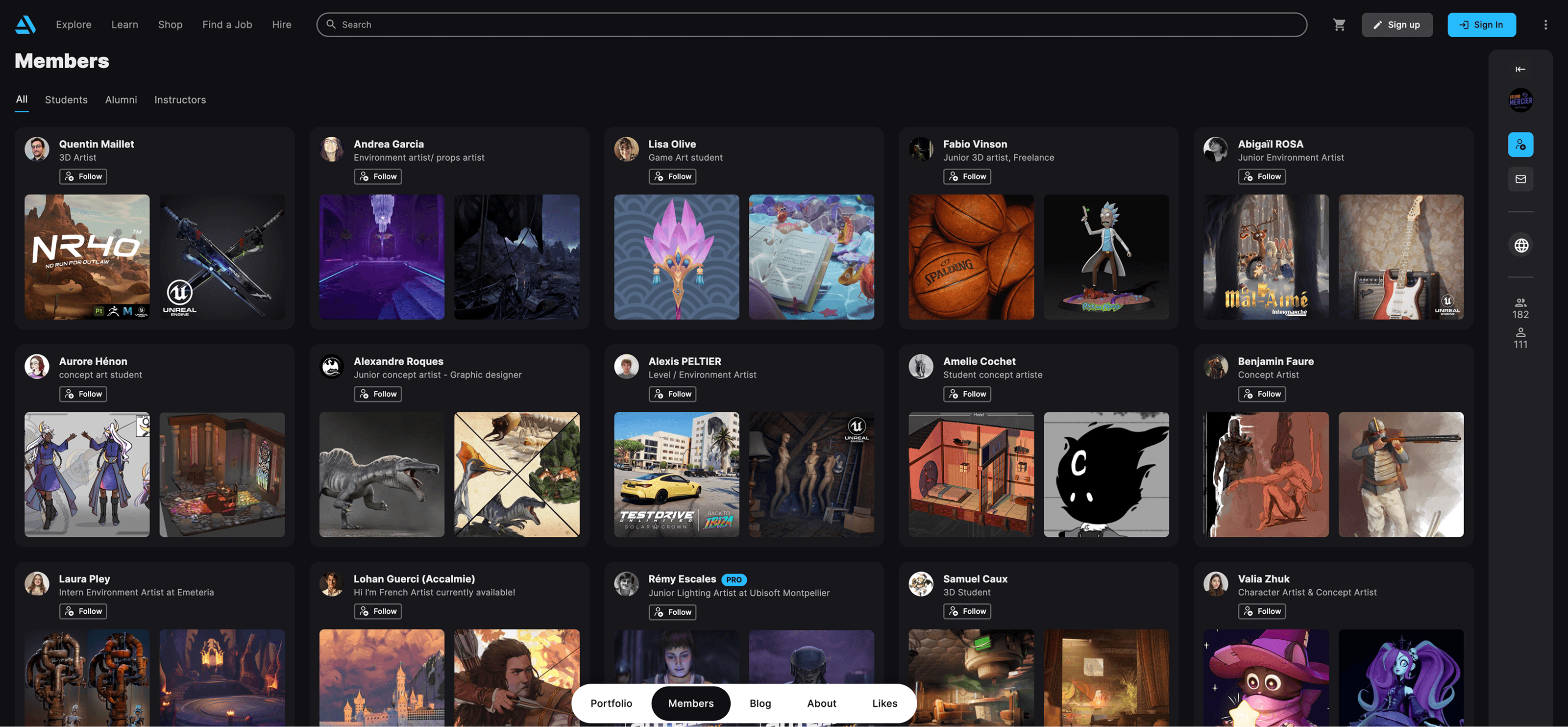
Dedicated tabs allowed schools to showcase different parts of their ecosystem. The portfolio tab highlighted student work, giving visibility to the quality of output. The members tab surfaced students, instructors, and alumni, helping make the community around a school more visible. Some schools also used blog posts to share updates, events, and insights.
The profile was only one part of the experience.
Dedicated tabs allowed schools to showcase different parts of their ecosystem. The portfolio tab highlighted student work, giving visibility to the quality of output. The members tab surfaced students, instructors, and alumni, helping make the community around a school more visible. Some schools also used blog posts to share updates, events, and insights.
Balancing structure and flexibility
Balancing structure and flexibility
Schools vary widely in size, focus, and offerings.
The structure needed to be consistent enough to support discovery and comparison, while still flexible enough to accommodate different types of schools. Standardized sections created familiarity, but the content within them adapted to each institution.
Schools vary widely in size, focus, and offerings.
The structure needed to be consistent enough to support discovery and comparison, while still flexible enough to accommodate different types of schools. Standardized sections created familiarity, but the content within them adapted to each institution.
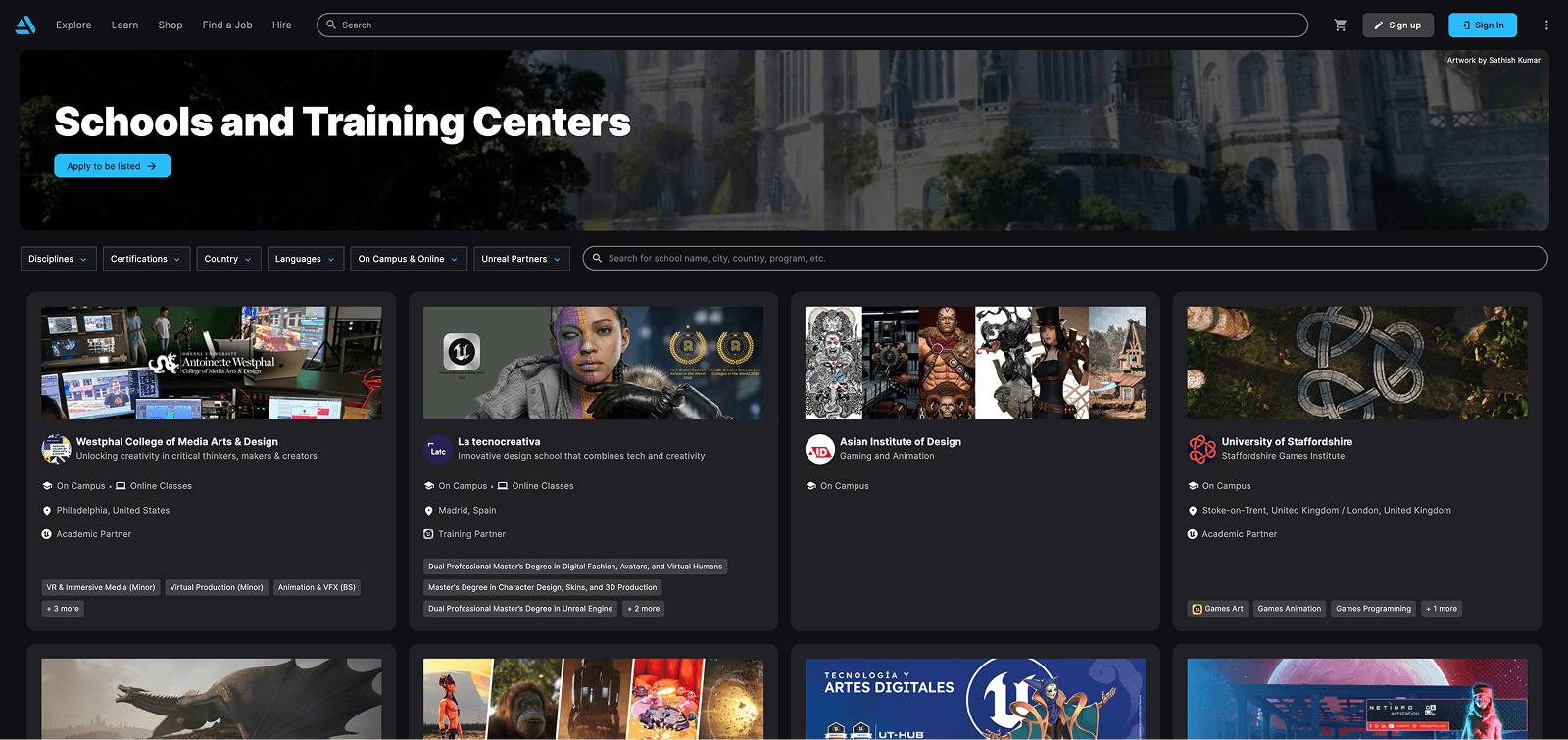
Discovery and browsing
Discovery and browsing
The profile was only one part of the experience.
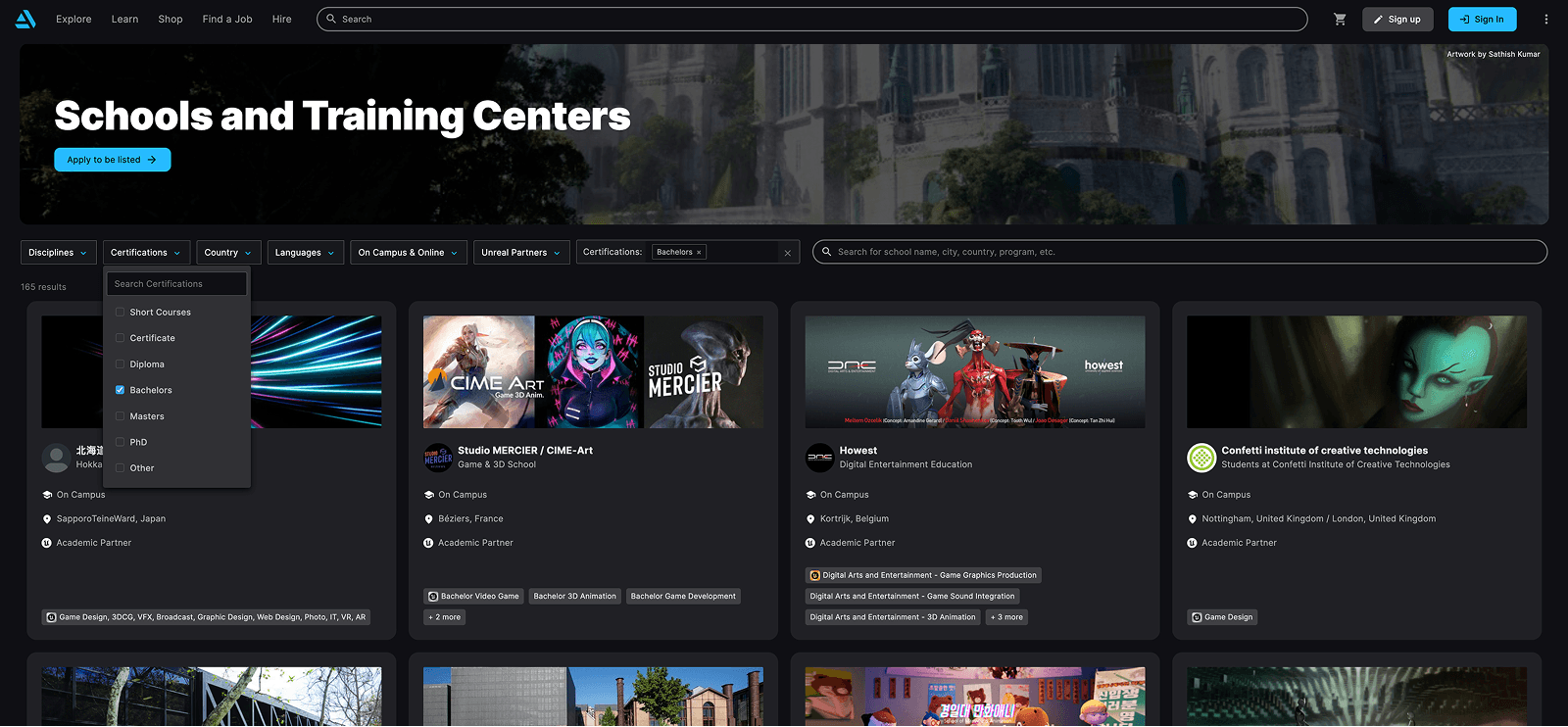
Schools were surfaced through listing views supported by filters and structured metadata, allowing users to explore based on criteria like discipline, location, and format.
The profile was only one part of the experience.
Schools were surfaced through listing views supported by filters and structured metadata, allowing users to explore based on criteria like discipline, location, and format.
What changed?
What changed?
School Profiles introduced a more structured way to represent institutions on ArtStation, shifting the experience from scattered information to something users could explore and understand with confidence.
School Profiles introduced a more structured way to represent institutions on ArtStation, shifting the experience from scattered information to something users could explore and understand with confidence.
Schools gained a dedicated presence, not just a listing
Schools gained a dedicated presence, not just a listing
Users could explore and compare programs more easily
Users could explore and compare programs more easily
Portfolio and member visibility highlighted student work and community
Portfolio and member visibility highlighted student work and community
Affiliation helped build trust between schools and prospective students
Affiliation helped build trust between schools and prospective students
The experience now supported the full journey: schools could present their programs, prospective students could explore options, and students could visibly connect their work to a school.
The experience now supported the full journey: schools could present their programs, prospective students could explore options, and students could visibly connect their work to a school.
The bottom line
The bottom line
Schools
+
Schools represented on ArtStation
Community
+
Students and alumni on the platform
Looking back
Looking back
This work went beyond UI and into product definition. It required thinking about schools as a distinct entity with their own structure and needs.
Defining that structure made it easier to present and compare information, but it also highlighted how disconnected parts of the experience still were.
There was an opportunity to connect schools, students, and outcomes more tightly across the platform. That could include strengthening how student work surfaced through school profiles and filters, improving how affiliation appears across the experience, and enhancing discovery through more intent-driven filtering and ranking.
That would have made the overall experience feel more connected, where users could explore schools, discover student work, and better understand potential paths into the industry.
This work went beyond UI and into product definition. It required thinking about schools as a distinct entity with their own structure and needs.
Defining that structure made it easier to present and compare information, but it also highlighted how disconnected parts of the experience still were.
There was an opportunity to connect schools, students, and outcomes more tightly across the platform. That could include strengthening how student work surfaced through school profiles and filters, improving how affiliation appears across the experience, and enhancing discovery through more intent-driven filtering and ranking.
That would have made the overall experience feel more connected, where users could explore schools, discover student work, and better understand potential paths into the industry.